Philadelphia Sept 23, 1926- Sept 23,2026
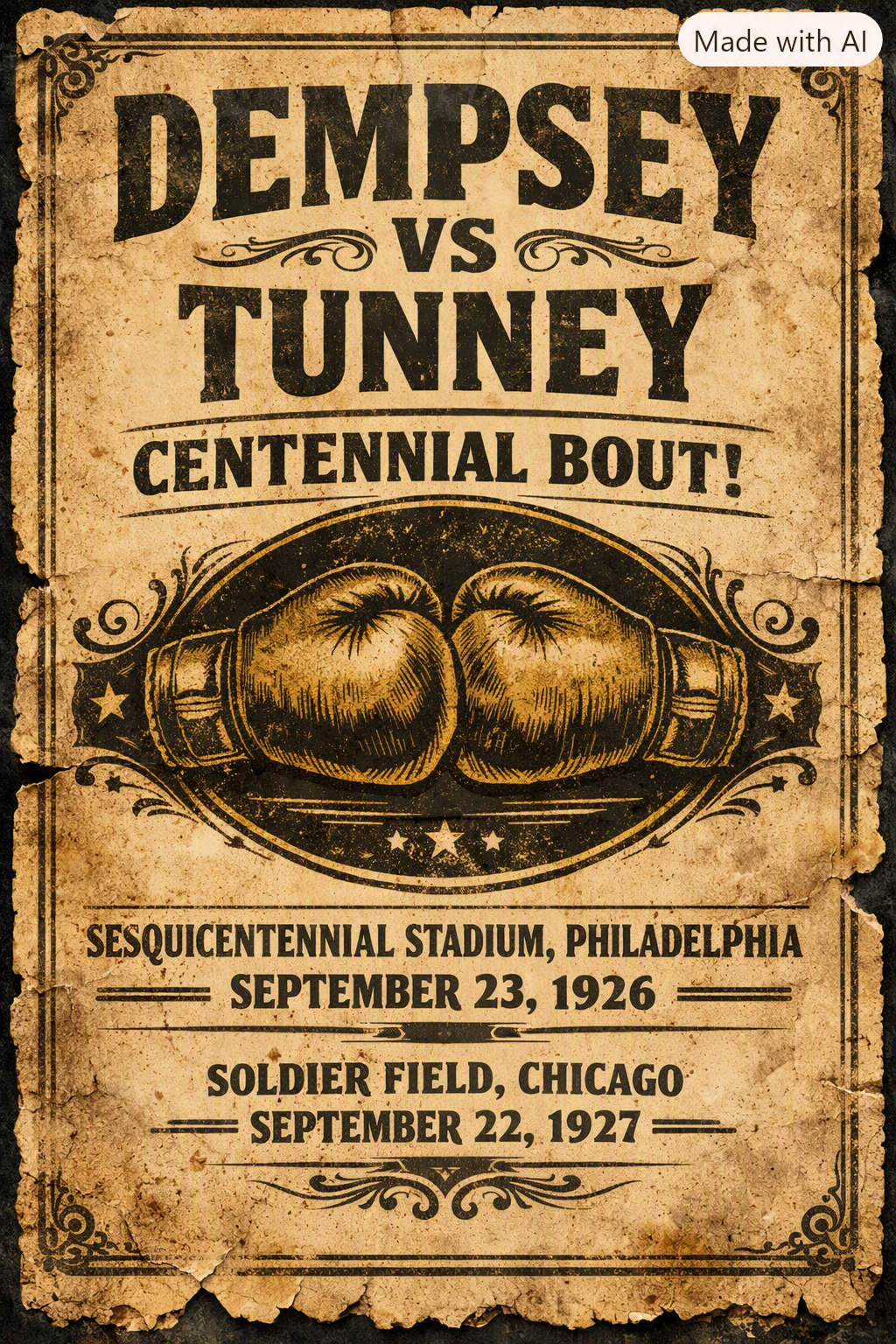
100th Anniversary of Champion Jack Dempsey defending his Heavyweight Championship belt on Sept. 23rd, 1926.
On this day, the torch was passed – Tunney, the clever boxer who read books, defeated Jack with a unanimous decision over 10 rounds.
The Dempsey–Tunney fight in Philadelphia refers to their first meeting, held September 23, 1926, at the Sesquicentennial Stadium — a massive temporary arena built for Philadelphia’s 150th anniversary celebration. It remains one of the most significant upsets in heavyweight history.
Tunney fought a near‑perfect tactical fight:
- Constant lateral movement
- Sharp one‑twos
- Never standing still long enough for Dempsey to set his feet
- Clinching at the right moments
- Maintaining distance and rhythm
Dempsey, after three years of inactivity, looked slow and hesitant — a stark contrast to the ferocious “Manassa Mauler” of earlier years.
Legacy of the Philadelphia Fight
- Named “Upset of the Decade” by The Ring.
- Set the stage for their legendary 1927 rematch in Chicago — the Long Count Fight.
Cemented Tunney as one of the most technically skilled heavyweight champions ever.
Tunney’s Tactical Blueprint
Tunney executed a military‑precision plan:
- Jab → pivot → right cross
He never stayed in front of Dempsey for more than a half‑second.
- Never let Dempsey set his feet
Dempsey’s power came from planting and exploding. Tunney denied him that moment every time.
- Clinch only when necessary
He didn’t hold excessively — just enough to break Dempsey’s rhythm.
- Punch first, punch last
Tunney initiated exchanges and ended them. Dempsey was stuck reacting.
- Condition for 15 rounds even though it was a 10‑round fight
Facts, Venue & Attendance
Sesquicentennial Stadium, Philadelphia
Paid attendance: ~120,557 (some reports say nearly 140,000 inside)
Gate: ~$1.9 million — the third million‑dollar gate in boxing history
Dempsey’s purse: ~$770,000
Tunney’s purse: ~$200,000
Philadelphia’s Sesquicentennial Stadium — the forgotten giant
This stadium was built for Philly’s 150th anniversary celebration. It seated 100,000+, making it one of the largest sporting venues ever constructed in America.
Key details:
- Temporary structure
- Wooden bleachers
- Massive oval design
- The fight drew 120,557 paid, with estimates of 140,000 actually inside
It remained the largest paid attendance in boxing until 1993.
The stadium was demolished shortly after the exposition ended — which is why so few people today know it existed.