Max Bear

%alt%

THE HARDER THEY FALL (1956)

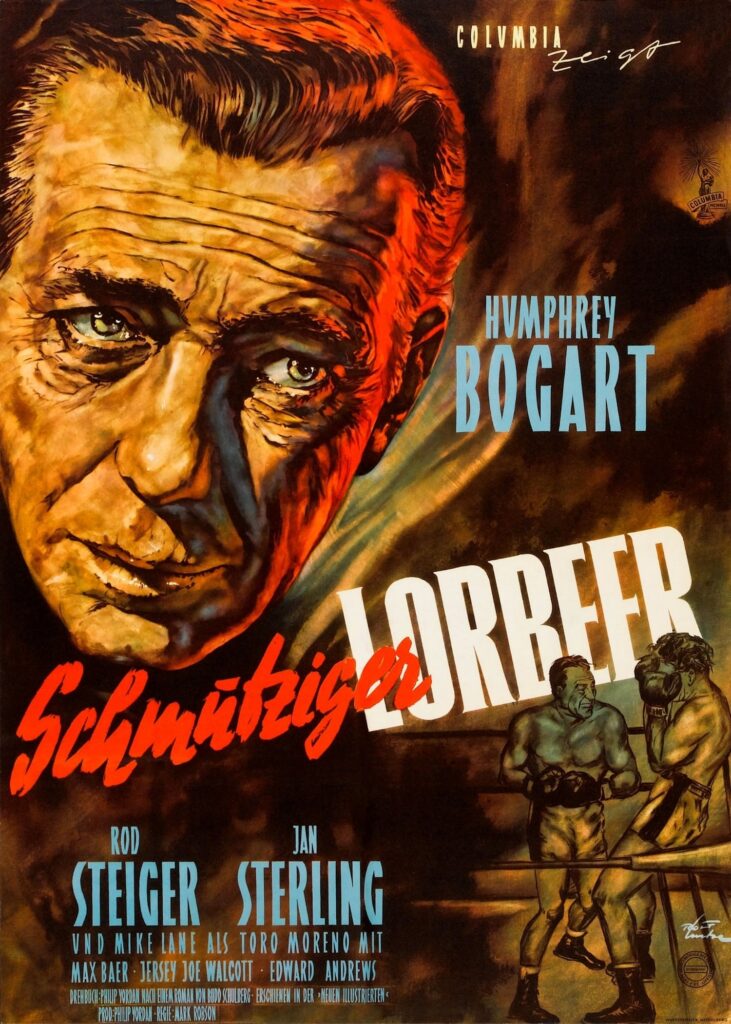
THE HARDER THEY FALL (1956) This is a review of the film The Harder They Fall, which was shown at The Theater in Huntington, New York, on March 12, 2025.  “The Harder They Fall” is a 1956 American boxing film directed by Mark Robson. The screenplay was written by Philip Yordan, based on Budd Schulberg’s 1947 novel of the same name. The film stars Humphrey Bogart alongside Rod Steiger and Jan Sterling in his final film role. The plot follows Eddie Willis (Humphrey Bogart), a down-and-out sportswriter who is hired by a shady boxing promoter, Nick Benko (Rod Steiger), to promote a new heavyweight fighter, Toro Moreno (Mike Lane). Despite Toro’s lack of fighting ability, Benko plans to use his size as a gimmick to draw fans to his fights. Eddie spins Toro as a legitimate up-and-comer, even though all of Toro’s fights are fixed. Eddie becomes increasingly conflicted about the scheme and its impact on Toro as the story unfolds. “The Harder They Fall” delves deep into the internal conflicts of its characters, especially Eddie Willis and Toro Moreno. Eddie Willis (Humphrey Bogart): Eddie grapples with his conscience and moral integrity throughout the film. Initially, he is drawn into the scheme to promote Toro because he is financially desperate. However, seeing the toll the deceit and exploitation take on Toro, he becomes increasingly guilt-ridden. Eddie’s internal conflict is the struggle between his need for financial stability and his growing realization of the ethical implications of his actions. His journey is a classic portrayal of a man torn between self-preservation and doing the right thing. Toro Moreno (Mike Lane): Toro is a kind-hearted, naive boxer who genuinely believes he can become a champion. His internal conflict centers around his self-worth and realizing his success is a sham. As he starts to understand the extent of manipulation and dishonesty in boxing, he struggles with betrayal and humiliation. Toro’s journey is disillusioned as he grapples with the harsh truths about the sport he loves and his place within it. These conflicts drive the narrative and add depth to the characters, making “The Harder They Fall” a compelling examination of the darker side of the boxing world and the human cost of corruption and deceit. “The Harder They Fall” features several characters involved in the criminal and corrupt aspects of the boxing world. Here are two of the notable hoodlum characters: Nick Benko (Rod Steiger): Nick Benko is the unscrupulous boxing promoter who masterminds the scheme to exploit Toro Moreno. He represents the darker side of the boxing industry, where money and power overshadow ethics and integrity. Benko’s manipulative and ruthless nature makes him a central figure in the film’s exploration of corruption. Jim Weyerhause (Edward Andrews): Jim Weyerhause is another of Benko’s associates involved in the financial and promotional aspects of the scheme. His role emphasizes the pervasive corruption that extends beyond the physical fights to the business side of boxing. The Good Guy Character Art Leavitt ( Harold J. Stone) is Eddie Willis’ friend and a fellow writer who shares Eddie’s disdain for boxing corruption. He provides a voice of reason and morality in the film, contrasting with the more unscrupulous characters involved in the boxing scam. Cast Of the Film Prominent cast members of “The Harder They Fall” (1956) have passed away. Humphrey Bogart, who played Eddie Willis, passed away in 1957. Rod Steiger, who portrayed Nick Benko, died in 2002. Jan Sterling, who played Beth Willis, passed away in 2004. Mike Lane, who played Toro Moreno, died in 2015. A Man’s Man: Before he was the Man, he was a Professional Boxer Bogart and his last film: Review The historic impact of  The Harder They Fall The Harder They Fall stands out among boxing films due to its intense focus on the corruption and exploitation behind the sport, which sets it apart from many other boxing movies that celebrate the grit, determination, and personal triumphs of their protagonists. Here’s a quick comparison: Grit and Glory: Movies like Rocky (1976) and Creed (2015) emphasize the underdog story, focusing on personal determination and the physical and emotional toll of fighting. They often inspire viewers with the protagonist’s perseverance. Dark Themes: Raging Bull (1980) and The Harder They Fall take a different approach, examining the darker sides of boxing. While Raging Bull explores Jake LaMotta’s personal struggles, including his violence and jealousy, The Harder They Fall delves into the exploitation of boxers and the ethical dilemmas faced by those in the industry. Social Commentary: Unlike boxing movies focusing on individual stories, The Harder They Fall critiques systemic injustice, making its message feel weightier. It’s more about the machine behind the sport than about a single boxer’s journey. Morality Over Action: While films like Million Dollar Baby (2004) balance poignant storytelling with engaging in-ring action, The Harder They Fall minimizes the boxing scenes and centers on the characters’ morality, especially Humphrey Bogart’s journalist and internal conflict. Next showing at the Cinema Arts Theater, Huntington, NY 730pm — April 14, 2025 — “The Setup” (1949) starring Robert Ryan, Audrey Totter. Wally Matthews presents . . . https://youtu.be/FlPA5APYzV0?si=Q683OkqQuhcV5bsGhttps://youtu.be/ZcRc_-XcYVQ?si=T6485MJ09QYvtweC Bogart Collection @Amazon

THE HARDER THEY FALL (1956) Read More »
%alt%

THE FAT GUYS OF BOXING

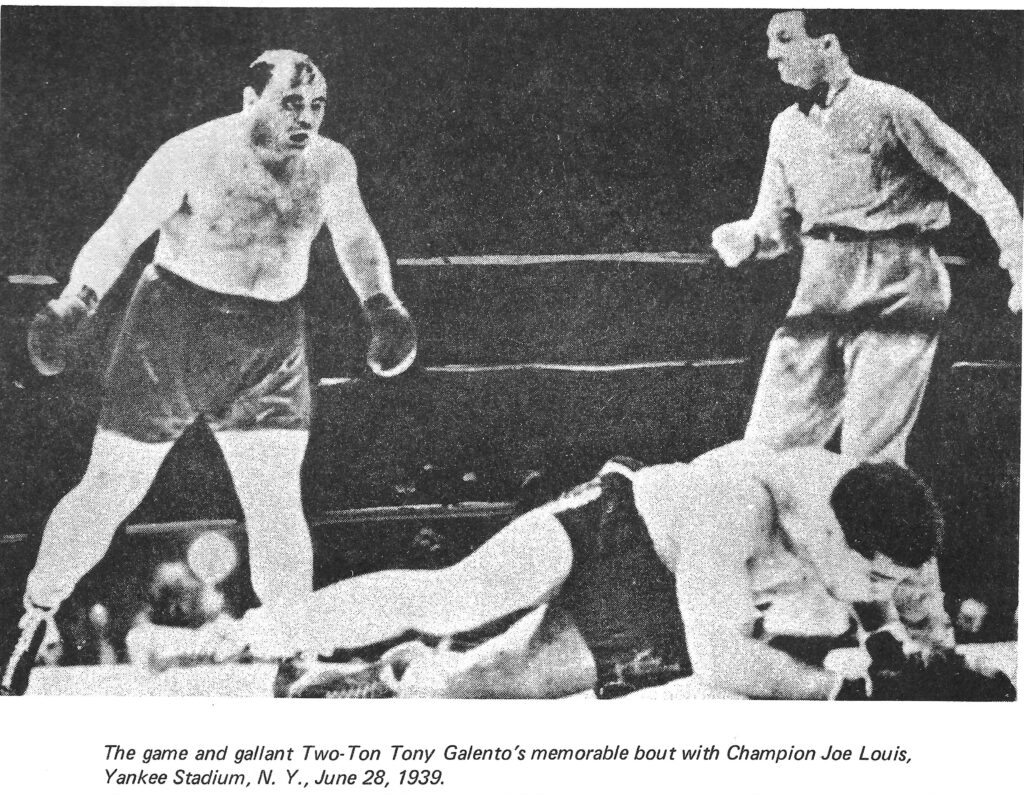
“Two Ton” Galento’s moment — floors Joe Louis in 1939. “Sailor” Willie Meehan The Fat Boys of Boxing (only heavyweights and beyond) In the historic land of heavyweight glory, few fighters threw out the discipline of the weight scale to challenge the top fighters of their day — and despite their size, some made it to challenge for the heavyweight title. One such customer was Buster Mathis, a huge heavyweight who challenged “Smokin” Joe Frazier in 1968 for the NYSAC heavyweight title since heavyweight since Muhammad Ali’s being stripped of his crown in 1967. The hulking 6’3 295 lb Mathis collapsed from the brutal Frazier attack, succumbing in the 11th round at the newly minted Madison Square Garden. Another “Fat” heavyweight was a character from New Jersey named Tony “Two Ton” Galento. Talk about a bar bruiser—Galento was all slugger and little science, but he did manage to garner a crack at the heavyweight crown against Joe Louis in 1939. The smallish 5’9 “, 240 lb Galento fought some of the toughest fighters of his era, such as Max Bear, Lou Nova and Arturo Godoy. Another “Fatboy” was an obscure West Coast sailer named Willie Meehan. Meehan was known as Jack Dempsey‘s kryptonite—a tough, four-round fighter who just had Dempsey’s number. In 1917, Dempsey had two wins, two losses, and two draws against Meehan—all four-rounders. In later life, Dempsey always acknowledged that Meehan was his toughest opponent. Several heavyweight boxers have been known for their larger physiques throughout boxing history. Here are other notable ones: Andy Ruiz Jr.: In 2019, Ruiz shocked the world by defeating Anthony Joshua to become the heavyweight champion. He weighed around 297 pounds for that fight. Claude Humphrey McBride, the 6’4 “, 360-pound heavyweight, was found by Midwest promoter Pat O’Grady and was considered the Butterbean of his day. After defeating contender Terry Daniels, McBride challenged Buster Mathis but was overcome by the latter’s experience.   Salvador Farnetti: Farnetti is known for his extreme weight, peaking at 342.5 pounds. He had a brief career with only 21 fights. Kevin Karusa: Karusa peaked at 346.5 pounds during his short professional career. Jarrell ” Big Baby” Miller, 6’4 “with unlimited weight” potential, has scaled past the three-hundred-pound meter a few times. Of the men on this list, Miller seems to carry the weight well for his size. Eric “Butterbean” Esch: Known for his massive size, Esch weighed close to 400 pounds at his peak. Despite his weight, he found great success in the ring, winning multiple world titles. Dustin Nichols: Nichols reached a peak weight of 450 pounds and had a record of 5-14-0. Antonio Johnson: Johnson weighed 380 pounds during his career and had a record of 7-3-1. https://youtu.be/Vndqe8ZI3BI?si=Yl3oZP6Iwjd4jPOm Buster Mathis Claude Humphrey McBride

THE FAT GUYS OF BOXING Read More »

%alt%

Joe Louis, an American Icon

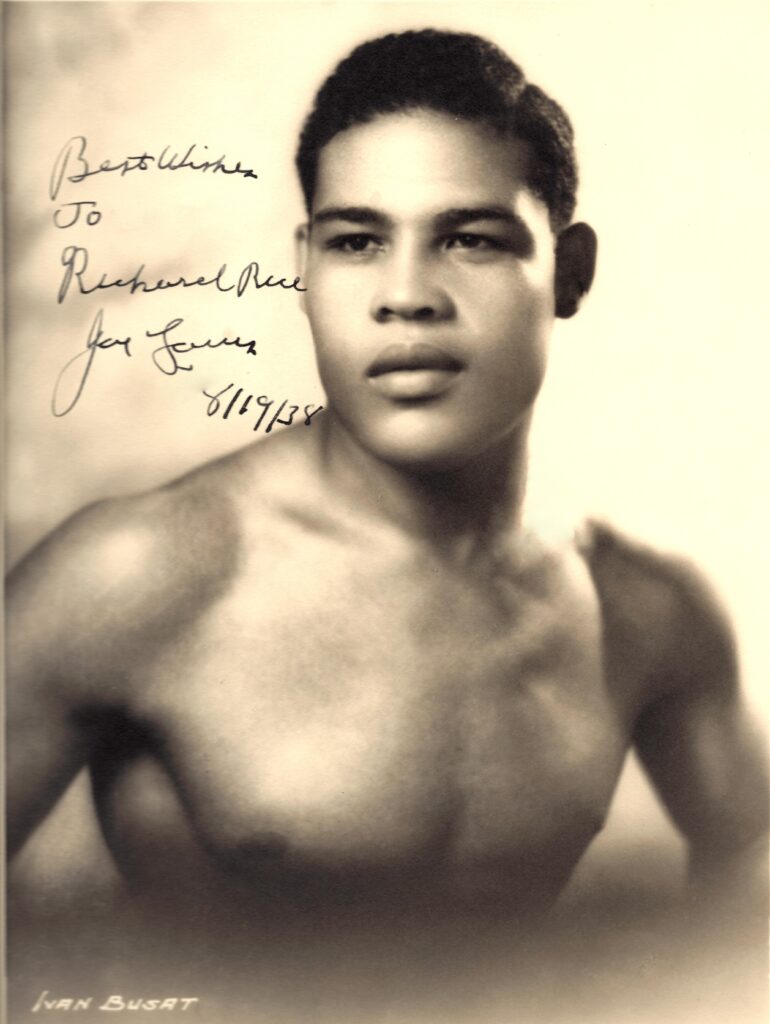
Joe Louis, professional name of Joseph Louis Barrow, American boxer known as  “The Brown Bomber.” Born in Lafayette, Alabama. Champion from 1937-1949, regarded as one of the elite heavyweight champions of the 20th Century. Louis holds the record for 25 title defenses. He won the world heavyweight title in 1937 from James J Braddock by an eighth round knockout. He retired briefly in 1949 and failed to regain the title from new champion Ezzard Charles in 1950. Prior to the Charles loss, the only other fighter to defeat Louis was Max Schmeling in 1936.  In addition to his boxing prowess, Joe Louis broke racial barriers and became a cultural icon. At a time when segregation and racial inequality were rampant in America, Louis’s success in the ring and his dignity outside of it earned him respect from people of all backgrounds. He became a hero to African Americans and was seen as a unifying figure during a divisive era.After retiring from boxing, Louis faced financial difficulties, including tax problems with the IRS, and his health declined. He passed away on April 12, 1981. Despite these challenges, his legacy as one of boxing’s all-time greats remains intact, and he is celebrated as a pioneer who transcended the sport to become a symbol of hope and resilience. Joe Louis paved the way for future African American athletes, showing that it was possible for a Black man to achieve success and be celebrated in mainstream American society. Louis’s legacy is also tied to his role in the integration of sports. While Jackie Robinson broke the color barrier in baseball in 1947, Louis’s success in boxing set a precedent that contributed to the eventual acceptance of Black athletes in other sports. Joe Louis passed away in 1981, but his legacy has lived on through numerous honors, including: Statues: There is a large statue of Joe Louis in Detroit, Michigan, his hometown, symbolizing his enduring connection to the city. Civic Honors: After his death, he was given a burial in Arlington National Cemetery, a rare honor for a civilian, acknowledging his contribution to the nation both in and out of the ring. Louis’s legacy is one of athletic greatness, cultural impact, and a role in advancing civil rights. He was a unifying figure during a divisive time in American history, and his influence is still felt today in sports, race relations, and American patriotism. Joe Louis, also known as the “Brown Bomber,” was an American professional boxer and one of the most famous heavyweight champions in the history of the sport. He held the world heavyweight title from 1937 to 1949, making him the longest-reigning heavyweight champion in boxing history. His reign lasted 12 years, and he defended his title 25 times, setting a record that still stands today. Louis was known for his powerful punching ability, disciplined technique, and calm demeanor in the ring. He fought in an era when boxing was one of the most popular sports in the U.S., and his success made him a national hero. Beyond his boxing accomplishments, Joe Louis was a symbol of hope and pride for African Americans during a time of racial segregation and discrimination in the United States. His 1938 rematch victory over German boxer Max Schmeling, after losing to Schmeling in 1936, was seen as a symbolic victory over the Nazi regime and a significant moment in both sports and political history. BULLETIN BOARD

Joe Louis, an American Icon Read More »

Shopping Cart
Verified by MonsterInsights